
Reverse Channel Letters and Halo Lit Letters: The Complete Guide
Key takeaways
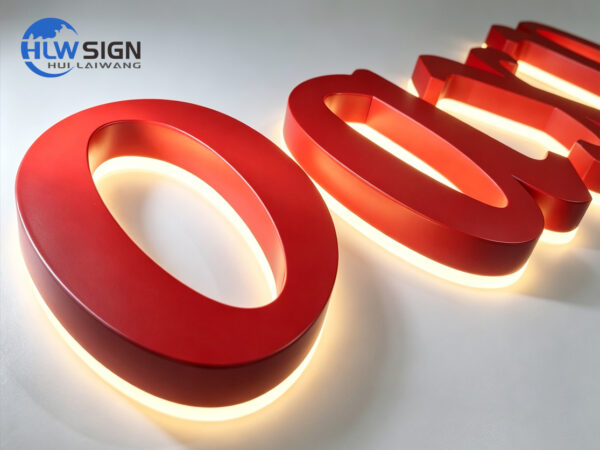
- The face is opaque and the light is aimed at the wall, so the letter reads as a silhouette with a halo.
- Face material and return depth are chosen together; the return controls the spread of light.
- Stand-off distance is the single decision that makes a halo look deliberate or accidental.
- Colour temperature must be consistent across the sign — on a wall, small differences are visible.
Reverse channel letters — also called halo lit or backlit letters — sit behind most hotel entrances and design-led shopfronts. Nothing about the sign is loud: the face stays dark and the light spills onto the wall. This guide covers the build from the inside out, and the details that decide whether it looks intentional.
Related reading: backlit channel letters and halo letters · gold electroplated backlit logo signs · backlit signs and halo letters design guide · discuss a halo sign project
How the construction works
- Face: opaque acrylic, painted metal, baked enamel or brushed stainless steel
- Return: stainless steel, aluminium or galvanised sheet, sized to control the light spread
- Lighting: high-output modules aimed away from the face, spaced more closely than a front-lit build
- Mounting: stand-off fixings, a concealed raceway, or a sub-frame that lifts the letters off the wall
- Sealing: the cable entry is what decides whether the sign survives ten winters
Choosing the face and the finish
| Face finish | Daytime character | Notes |
|---|---|---|
| Baked enamel | Smooth, saturated colour | Durable; the usual choice for retail and hospitality |
| Brushed stainless | Soft metallic sheen | Hides handling marks better than mirror finishes |
| Mirror stainless | High shine, architectural | Shows fingerprints and seams; needs clean outlines |
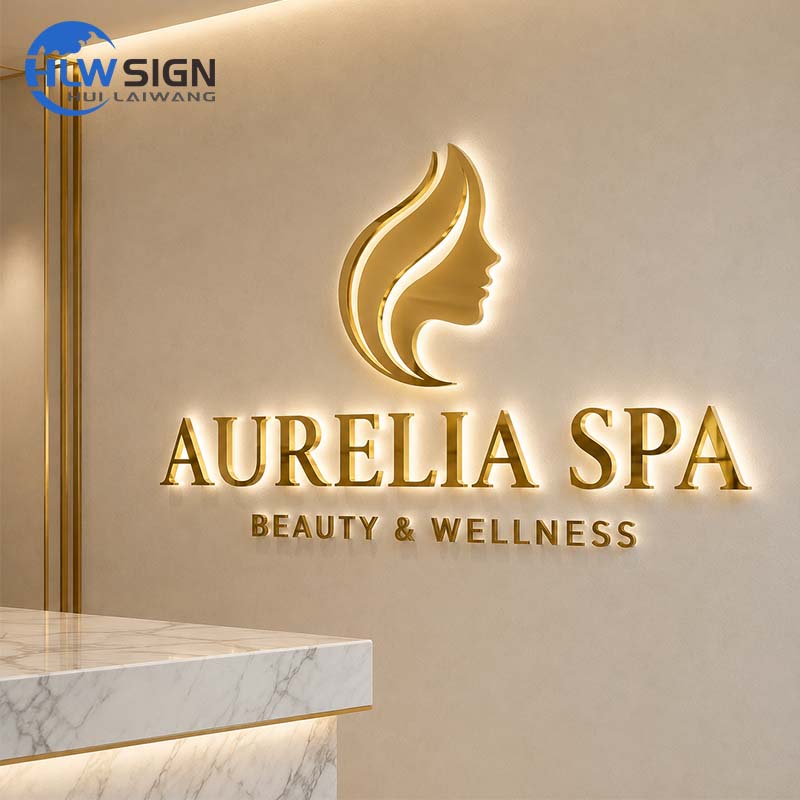
| Electroplated gold | Luxury accent | Titanium gold, champagne gold, rose gold and black steel options |
Getting the halo even
- Stand-off: too close and the halo collapses into a line, too far and it washes into a blur
- Wall surface: smooth and light gives the cleanest halo; dark brick absorbs light and flattens it
- Module layout: laid out per letter rather than per metre, because tight curves need more density
- Colour temperature: fixed for the whole sign — 3,200 K, 4,500 K, 6,500 K or 10,000 K
- Testing: a continuous 24-hour lighting test and photo or video approval before packing
Send a daylight photo of the wall and the approximate letter height. We will recommend the stand-off and module density — and say so honestly if the wall will not produce an even glow.
Where reverse channel letters work best
- Hotel, restaurant and hospitality entrances, seen from a few metres rather than a dual carriageway
- Office receptions and corporate interiors, including backlit reception logos
- Premium retail and beauty brands with warm, low-contrast interiors
- Residential house numbers and name signs, where a bright face would look out of place
- Heritage and listed facades where illumination has to stay discreet
On a long roadside view, front-lit letters remain the right answer — the halo is a close-range effect. We will tell you that rather than sell the more expensive build.
Conclusion
Reverse channel letters are a lighting design as much as a sign. Choose the face finish for daylight, the return depth for the spread, the stand-off for the effect and the colour temperature for the mood. Get those four right and the sign reads as expensive in daylight and after dark.
Frequently asked questions
What is the difference between reverse channel letters and backlit letters?
They describe the same construction from two angles: reverse refers to the light being aimed backwards inside the letter, while backlit describes the halo the viewer sees on the wall. The face stays opaque in both.
Can halo lit letters be installed on any wall?
Most surfaces work, but dark or heavily textured walls absorb light. Send a daylight photo and we will recommend the stand-off and module density, or suggest a front-lit construction if the surface will not give an even glow.
Do you supply the fixings and drawings?
Yes. Every order ships with installation drawings, wiring instructions, mounting templates and accessories, plus installation videos and technical support.
Sources and further reading
- Backlight — Wikipedia — How backlighting is used in practice.
- Color temperature — Wikipedia — What 3,000 K to 10,000 K means on a sign.
- Channel letter — Wikipedia — Includes the reverse-lit construction.
- Stainless steel — Wikipedia — Return materials and finish options.
External links above point to independent reference material. We are not responsible for the content of external sites.