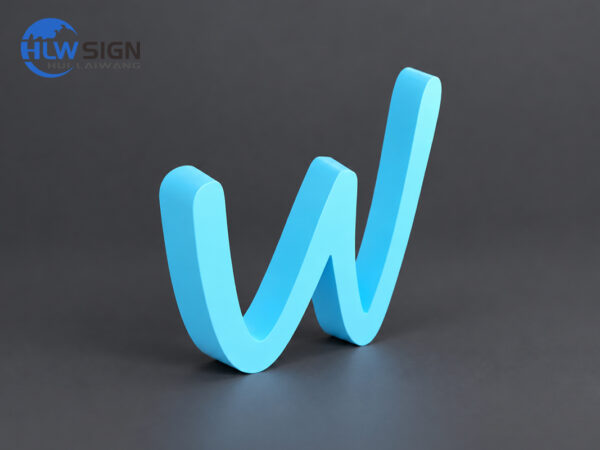
Metal Letters and 3D Signs: Enamel, Stainless and Gold Finishes
Key takeaways
- Non-illuminated metal letters are lighter, thinner and simpler to install than illuminated builds, and they need no wiring or driver.
- Baked enamel gives the most saturated colour; brushed stainless the most durable surface; mirror and gold finishes the strongest design statement.
- Match the letter depth to the viewing angle — a 20 mm return reads as flat from the side, 60 mm reads as properly three-dimensional.
- Spray finishes can be matched to PANTONE or RAL, so the letters sit correctly next to existing brand paint.
Illuminated signage gets most of the attention, but a large share of the signs we manufacture never light up at all. Non-illuminated metal letters and 3D logos suit interiors, heritage buildings, offices and any façade where a glowing face would look out of place. This guide compares the finishes we build most often, and the details that decide whether the result looks sharp or homemade.
Related reading: non-illuminated custom metal signs · 3D embossed metal letters · baked enamel stainless steel 3D letters · brushed stainless steel wall letters
Why choose non-illuminated metal letters
- No electrical work, no driver, no wiring entry point to seal — simpler to install and simpler to maintain
- Thinner and lighter than illuminated letters, so they suit interior walls and slim fascias
- Daytime appearance is the whole design, which makes the finish and the edge quality the main event
- Lower cost per letter than an illuminated build of the same size
The trade-off is obvious: at night the sign relies on external lighting. If the site is dark and unlit, that is the point at which an illuminated build starts to earn its cost.
The four finishes we build most
Baked enamel letters
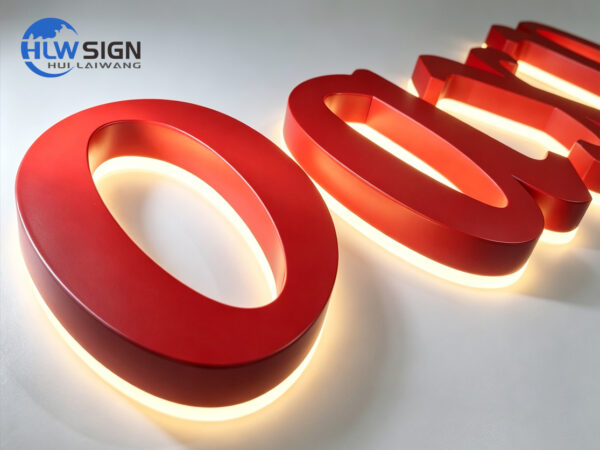
A powder-and-bake process that produces a smooth, saturated colour with excellent weather resistance. It is the finish behind most coloured shopfront letters and 3D logos. Because the colour comes from the coating rather than the metal, this is the build to choose when brand colour accuracy matters.
Brushed and mirror stainless steel
Brushed stainless has a soft directional sheen that hides handling marks and looks at home on office reception walls. Mirror stainless is the opposite: a high-shine surface that makes a small logo feel architectural. Mirror finishes show fingerprints and any seam in the fixing, so they are usually reserved for interiors or for letters with clean, simple outlines.
Electroplated and gold letters
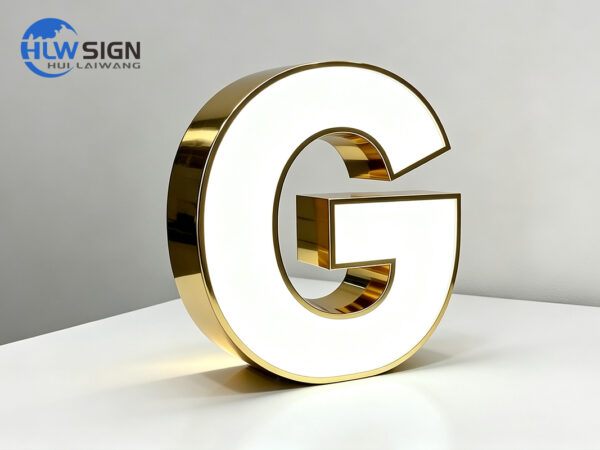
Electroplating adds titanium gold, champagne gold, rose gold and black steel, while water plating produces antique bronze, antique brass and antique copper. Gold letters are the standard choice for jewellery retail, hotel and cosmetics branding, where the sign needs to read as a premium material rather than a painted surface.
Embossed and raised metal signs
Embossed signage raises shapes or lettering out of a flat metal panel, so the graphic and the background are one piece of metal with no visible fixing between them. It is a good fit for plaques, plaques with fine detail, and designs where a separate 3D letter would be too small or too fragile.
Sizes, depth and the rules of thumb
Metal letters are forgiving to specify, but two dimensions decide how three-dimensional the result actually looks.
| Letter height | Typical return depth | Where it suits |
|---|---|---|
| Up to 20 cm | 10–20 mm | Interior wall logos, reception signage, door lettering |
| 20–40 cm | 30–40 mm | Shopfront letters, fascia branding, office exteriors |
| 40–70 cm | 50–60 mm | Building entrances, large wall logos |
| Over 70 cm | 60 mm and above | Rooftop and façade lettering, viewed from below |
- Faces are typically formed from 0.5–0.8 mm stainless steel, galvanised sheet or aluminium alloy
- Minimum stroke width is about 2 cm; fine script and thin serif fonts generally need 20 cm of height to stay clean
- Powder coating and spray painting can follow any PANTONE or RAL reference
- Letters can be supplied with stud fixings, a concealed rail, or a paper template for drilling on site
Fixing methods: wall, hanging and freestanding
- Wall-mounted with concealed studs — the cleanest look, and the default for interiors
- Wall-mounted on a visible rail — easier to level and to service, common for larger letter sets
- Hanging from a soffit or canopy — used for entrance signage and covered walkways
- Freestanding or on a sub-frame — for signs that need to stand clear of the surface, such as heritage façades where drilling is restricted
Every order leaves us with a set of installation drawings and a mounting template, so the fixing points can be set out accurately before the sign arrives on site.
Conclusion
Pick baked enamel when colour accuracy matters, brushed stainless when the sign is touched and cleaned often, mirror or gold finishes when the material itself is the message, and embossed panels when the graphic needs to be one continuous piece. Then spend the same attention on the return depth and the fixing method — those two decisions are what separate a sign that looks made for the building from one that looks attached to it.
Frequently asked questions
Can 3D metal letters be used outdoors without illumination?
Yes. Non-illuminated letters are common on heritage façades and interiors, and with a baked enamel or powder-coated finish they hold up outdoors for years. The only real question is whether the site has enough ambient light at night — if not, we would add illumination.
How much do custom 3D metal letters cost?
Price follows letter height, character count, material and finish, because a brushed stainless letter set and a gold-plated one are different production jobs. Send the wording, height and finish and we will quote it as a factory-direct price.
Can metal letters be produced in a custom brand colour?
Yes. Custom spray painting can follow your PANTONE or RAL reference, and stainless steel parts are also available in brushed or mirror finishes with electroplated options including titanium gold, champagne gold, rose gold, black steel, antique bronze and antique brass.
Do you make metal letters in small sizes?
Yes. Small lettering is common for interior logos and door signage. Stroke width is the real constraint: below roughly 2 cm strokes become difficult to form cleanly, so we may recommend an embossed panel or a printed plaque instead.
How are metal letters packed for shipping?
Letters are individually wrapped, then crated with a mounting template and the fixing accessories. Photos or videos of the finished sign are sent for approval before packing.
Sources and further reading
- Powder coating — Wikipedia — The finish technology behind baked enamel signage.
- Electroplating — Wikipedia — How gold, champagne and antique metal finishes are applied.
- Stainless steel — Wikipedia — Grades and properties relevant to exterior lettering.
- UL Solutions — Product safety certification body.
External links above point to independent reference material. We are not responsible for the content of external sites.