Vinyl Lettering vs Dimensional Letters: Which Should Be on Your Wall?
Key takeaways
- Vinyl is cut or printed film on a surface; dimensional letters are fabricated objects fixed off it.
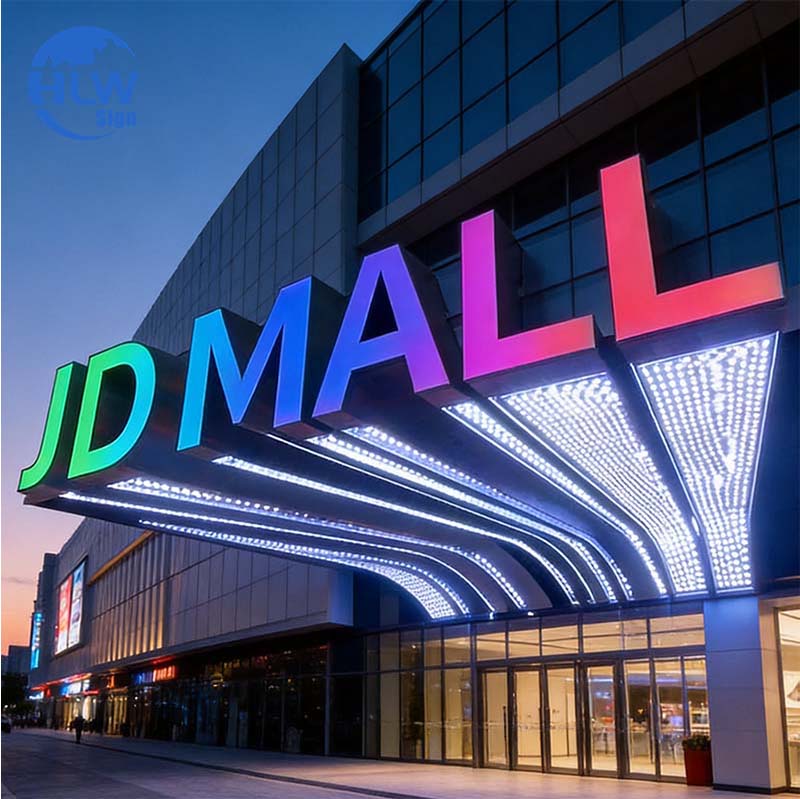
- Dimensional letters cast shadow and read from more angles, which is why they photograph better.
- Vinyl suits flat indoor surfaces and short-term graphics; dimensional letters suit facades and long-life branding.
- Hybrids work well: printed vinyl in the window, fabricated letters on the facade.
This is one of the first decisions on any signage project, and it is usually framed as a budget question when it is really a longevity question. Vinyl and dimensional letters solve different problems — here is how to tell which one you actually need.
Related reading: metal letters and 3D signage finishes · custom metal and embossed signs · 3D embossed metal letters · signage design that reads from the street
What each product is
- Vinyl lettering: cut or printed film applied to glass, panels or a painted wall, usually 50–150 µm thick
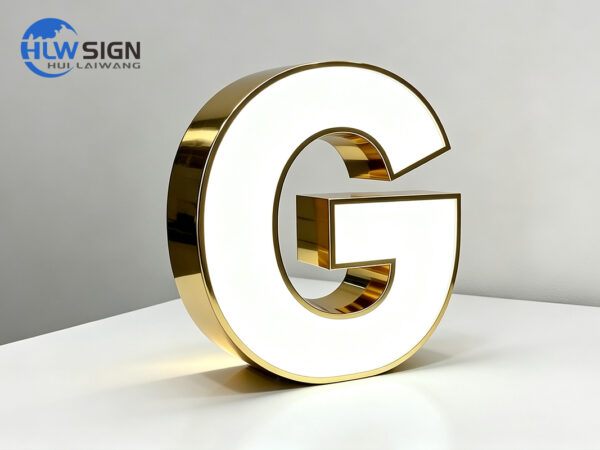
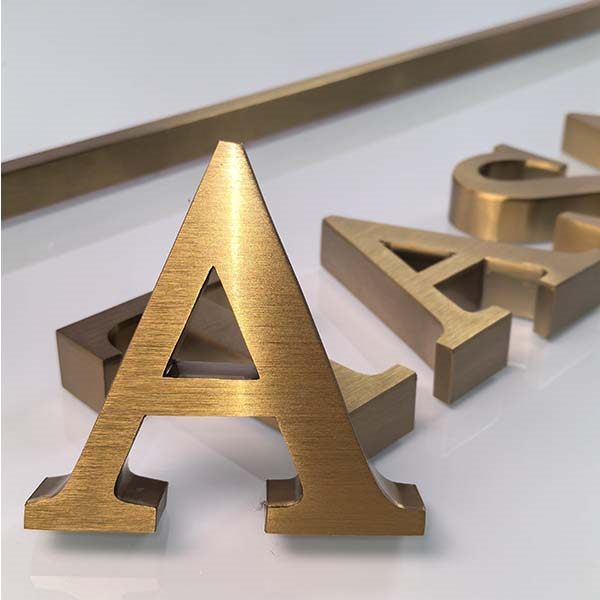
- Dimensional letters: fabricated letters — acrylic, stainless steel, aluminium or baked enamel — mounted on studs, a rail or a template
- Hybrid: printed or cut vinyl on a rigid panel that is then mounted off the wall
- Hybrid: a fabricated letter with a printed face, giving shape plus full-colour graphics
The comparison that matters
| Consideration | Vinyl lettering | Dimensional letters |
|---|---|---|
| Appearance | Flat, graphic, part of the surface | Three-dimensional, casts shadow, changes with light |
| Best use | Windows, interior walls, vehicles, campaigns | Facades, reception walls, entrances, long-life branding |
| Lifespan outdoors | Typically a few years before fading or lifting | Decade-scale when material and fixings are specified correctly |
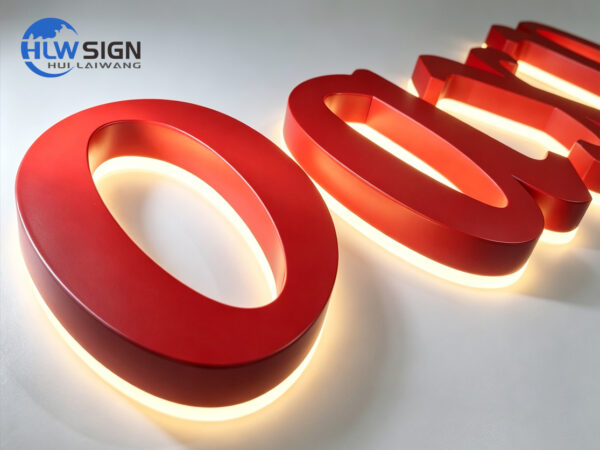
| Illumination | Cannot be illuminated on its own | Front-lit, backlit or non-illuminated |
| Surface tolerance | Needs a smooth, clean, flat surface | Handles panels, brick and uneven walls with the right fixings |
| Change cost | Cheap to update | Higher to change, so the design should be right first time |

Where each belongs in a real project
- Facade and entrance: dimensional letters, illuminated if the business trades after dark
- Shop window: vinyl graphics for offers and opening hours, replaced as they change
- Reception wall: dimensional letters or a backlit logo, because that wall gets photographed
- Wayfinding and door plates: flat graphics or small non-illuminated letters
- Temporary or seasonal: vinyl, because it is meant to come off
Send a photo of the wall and tell us what it is made of. The surface, the viewing angle and the lighting decide this more often than the budget does.
Specifying dimensional letters well
- Return depth: 10–20 mm suits interiors, 30–40 mm reads properly on a shopfront, 50 mm and above for large letters seen from below
- Finish: baked enamel for saturated colour, brushed stainless for durability, mirror and gold finishes where the material is the statement
- Fixing: concealed studs for the cleanest look, a rail for uneven walls, a template for accurate drilling
- Colour matching: spray painting follows any PANTONE or RAL reference so the sign sits with existing brand paint
Conclusion
Choose vinyl when the surface is flat, the need is graphic and change is likely. Choose dimensional letters when the sign is part of the building, will be photographed, or has to survive ten winters. Where the budget is tight, use vinyl in the window and dimensional letters on the facade — that is where each one earns its place.
Frequently asked questions
How long does vinyl lettering last outdoors?
Typically a few years before fading or lifting, depending on sun exposure and the surface. Dimensional letters in stainless steel or aluminium with a baked finish last far longer, which is why facades normally use them.
Are dimensional letters much more expensive than vinyl?
They cost more per character because they are fabricated objects rather than applied film. Over time the comparison shifts: vinyl is replaced every few years, while a well-specified dimensional sign is a one-off purchase.
Can dimensional letters be illuminated?
Yes — front-lit, backlit and non-illuminated constructions are all available, and we will recommend the one that suits the viewing distance and the wall.
Sources and further reading
- Vinyl — Wikipedia — The base material for cut and printed graphics.
- Poly(methyl methacrylate) — Wikipedia — The acrylic used for dimensional letter faces.
- Stainless steel — Wikipedia — Grades and finish options for metal letters.
- Signage — Wikipedia — Where flat graphics and dimensional letters fit in a scheme.
External links above point to independent reference material. We are not responsible for the content of external sites.